


On Our Minds
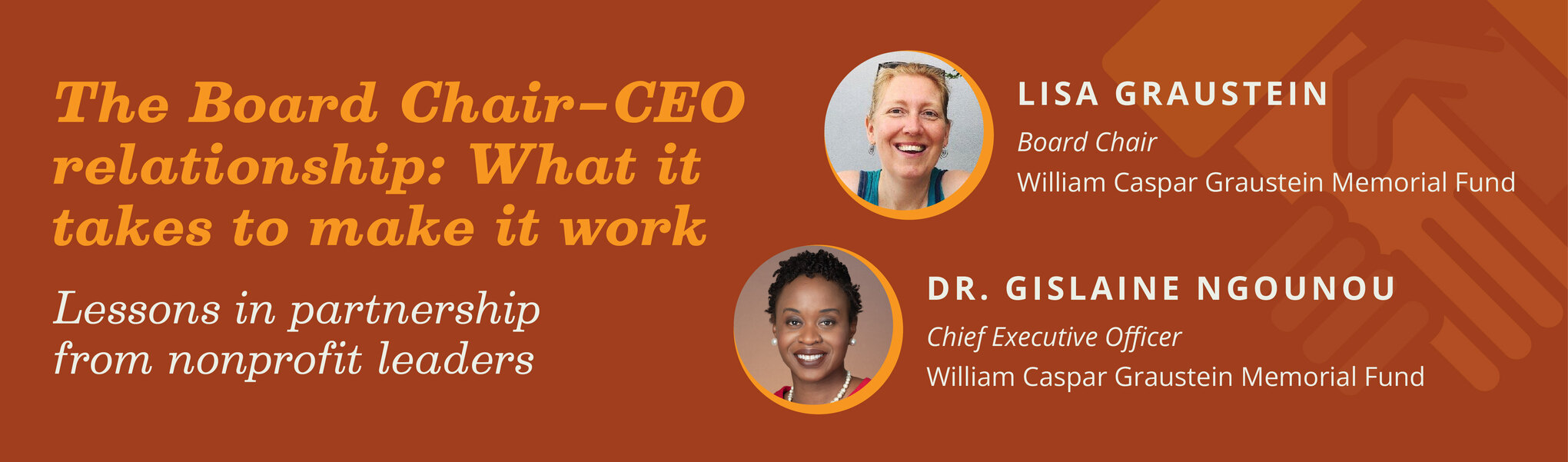
The Board Chair–CEO relationship doesn’t always get the attention it deserves. But in my work at On-Ramps, I’ve come to see it as one of the most consequential partnerships in any organization.
Lisa Graustein, Board Chair of the Graustein Memorial Fund, and Gislaine Ngounou, the Fund’s CEO, have thought carefully about how to navigate it successfully. And they’ve built a partnership grounded in trust, honest conversation about power, and structures that keep them aligned through complexity. I sat down with them to hear what that’s looked like in practice—and what other organizations might learn from their experience.
Why the relationship is so significant
“This relationship really sets the tone and the model for how we want to be and who we want to be in the work that we do.”
— Gislaine Ngounou
When I asked Lisa and Gislaine why the Board Chair–CEO relationship is so central to organizational effectiveness, both came back to the same idea: It’s a seed from which everything else grows.
Gislaine put it this way: the relationship is “a critical link between governance and management” that plays a huge role in strategy development and implementation—but also in how an organization sets vision; communicates honestly with trustees, staff, and partners; and ultimately lives into its values. It models, for everyone watching, who the organization wants to be.
Lisa added a layer: “I hold the culture for the board; Gislaine holds the culture for the staff. And where we interface and how we interface ripples in both directions.” When the relationship is strong, that ripple is generative. When it isn’t, the whole organization feels it.
Building trust—and naming the dynamics that shape it
Both Lisa and Gislaine were clear that trust doesn’t happen by default. It’s actively built—and that work begins earlier than most people think.
For them, it started during the hiring process. Lisa was explicit about the dynamics she knew would shape their relationship: both the intergenerational family dynamics of a family foundation and the racial and class dynamics of this particular relationship.
Lisa wanted Gislaine to have as much information as possible in making her decision. And she did something Gislaine had never experienced before. She offered to provide references on herself—specifically references who could speak honestly to her strengths and gaps in that kind of relationship.
“I was truly amazed by that offering,” Gislaine said, “especially given the power dynamics and imbalance.” It signaled something important: that the interview process goes both ways.
From there, trust-building became an ongoing practice. They named four elements that have mattered most:
- Seeing each other as humans. That means making space for the personal, checking in on each other as people, and resisting the pull toward pure productivity. “We prioritize relationships and wellbeing,” Gislaine said, “alongside caring deeply about doing good work and being in service to communities.”
- Honest, two-way feedback. Their weekly check-ins and quarterly retreats always begin with a personal check-in, and regularly include a direct question: How are we working together and what do we need to adjust?
- Confidentiality and grace. Trust requires knowing that the person across from you will meet you with curiosity rather than judgment. That shows up in small moments as much as big ones. Questions like “is that something you feel you have to do, or is it a choice?” provide inquisitive care that, Gislaine noted, “honors my choices as a fully capable woman and leader."
- Having each other’s back. “When I’m in a room, I know I have cover,” Gislaine said. “Because no matter what happens, I feel like Lisa is operating from a principle of ‘I have your back.’” And the same runs the other direction. “Trust is born of an understanding that we share values and an ultimate aim, even if holding different perspectives on tactics at times—and that we give each other truth, grace, and love.”
Developing structure to maintain stability
“It’s easier to hold time for regular check-ins and then release it if we don’t need it, than to try to find time at the last minute.”
— Gislaine Ngounou
Specific structures help sustain a strong working relationship between a Board Chair and a CEO.
- Weekly or biweekly check-ins. They hold these consistently, with a norm of protecting the time while remaining open to letting it go or pivoting when things get busy.
- Quarterly retreats. The weekly/bi-weekly cadence keeps things moving, but it can also keep you in the weeds of tactical or reactionary day-to-day work.“We periodically need sustained time with each other,” Gislaine said—time to step back, assess how the relationship is functioning, and think strategically.
- A practice of debriefing new things. Lisa described an informal but important structure: whenever they do something for the first time—offer each other unsolicited critical feedback, navigate a disagreement, work through an unclear situation—they do a brief debrief afterward. How did that go? How did that land? Could I have done that better?
- Moments of joy and acknowledgment. This one might surprise people, but both Lisa and Gislaine named it. Lisa, who is also an artist and former high school teacher, often leads teambuilding activities that encourage people to play, laugh, tap into creativity, share what inspires them, and connect on a different level. “You can feel the energy shift during these experiences and folks come to meetings on time so they don’t miss these moments,” said Gislaine, also a former teacher.
Navigating the current moment
“Adaptiveness without clarity is confusing to everybody. But adaptiveness with clarity allows people to move well.”
— Lisa Graustein
For justice-focused organizations right now, the external pressure is real—and it isn’t going away. Lisa and Gislaine were candid about how the Chair–CEO partnership becomes even more essential under those conditions.
One practical example: early in Gislaine’s tenure, she raised a concern about the Fund’s process for issuing public statements. In a world moving fast, waiting for approval on every communication risked missing opportunities to contribute to important topics.
What followed was a collaborative process that produced a set of core communication principles—approved by the board—that now allow Gislaine and her team to move in real time, checking themselves against shared values rather than cycling through bureaucratic sign-off. “It’s not perfect,” Gislaine said, “but it’s been really, really helpful.”
More broadly, Lisa described the discipline of prioritizing and assessing capacity during a moment when everything feels urgent: “There is so much that needs to get done right now. We can’t do it all.” The board’s job, she said, is to be clear about expectations, listen with curiosity and trust, and hold space for ongoing conversation about the rest. “Those are never one-and-done conversations.”
Gislaine added that when things get hard, she and Lisa return to a shared anchor: values, mission, and vision. “Those are agreements that we have with everyone. It’s helpful to be reminded when things are hard, and there is fear and overwhelm.”
What to watch for and when to recalibrate
“It’s the board chair’s job to regularly ask the CEO: what can I do to better support you? What do you need?”
— Lisa Graustein
Even the healthiest partnerships need tending, and there are clear signals when something needs attention. Lisa and Gislaine named a few.
- Too many surprises. When new initiatives, communications, or decisions start catching people off guard more than once, Gislaine said, it’s time to pause. “That’s probably a sign that we need to talk about the why and what’s happening.”
- Cliques and side loyalties. Longstanding relationships that predate the current leadership—between subsets of board members, or between board members and individual staff—can have major influence. Naming and addressing those dynamics early matters.
- Waning enthusiasm. Lisa watches for this closely: “Everyone in our organization is deeply committed to the mission. When there’s no enthusiasm, something’s not aligned.” It might mean someone is overworked, unclear on direction, or unsupported. “Our job is to nurture the conditions needed for our brilliant staff to do their best work.”
- Working beyond capacity. If the board’s expectations for what the Fund can do exceed staff capacity, it’s important to get at the root cause rather than just accept the dynamic as a norm.The Board Chair-CEO partnership is an important structure to pressure check and discuss how to rightsize expectations and practices.
Final thoughts
What struck me most in this conversation wasn’t any single practice or structure. It was the shared conviction that how they show up with each other is inseparable from how the organization shows up in the world. The relationship isn’t a means to an end. It is the work.
The closing note from Gislaine was one I’ll carry with me: “Don’t take the partnership for granted and assume it’s just gonna work. See the Chair–CEO partnership as a key strategic structure that is deserving of time, intentionality, resources, and feedback. Like any good piece of infrastructure—it should be nurtured, not assumed.”
______________
On-Ramps is a search and consulting firm that serves mission-driven organizations in the social sector. We are deeply committed to helping create diverse, equitable, and inclusive workplaces. Together with our clients, we thoughtfully consider and address these topics throughout every step in our process.
Want to talk about relationship building during the search? Reach out to Cindy Menz-Erb at info@on-ramps.com.
